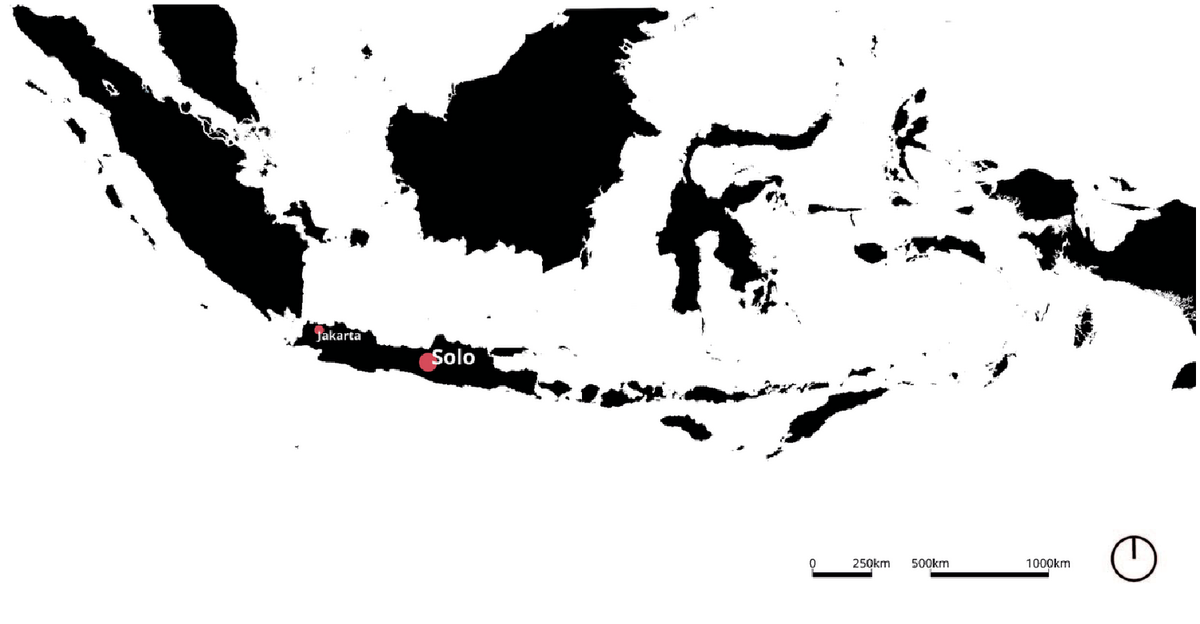
Solo — officially known as the City of Surakarta — is a secondary city located in Central Java Province, Indonesia. Covering an area of 46.72 km², Solo had a population of approximately 526,870 residents (2024).
Historically regarded as the heart of Java, Solo served as the former capital of the Javanese Mataram Kingdom. Today, it functions as a key economic, cultural, and service hub for the southern part of Java, connecting to several surrounding regencies: Boyolali, Sukoharjo, Karanganyar, Wonogiri, Sragen, and Klaten.
Geographically, Solo is situated inland, making it particularly exposed to urban heat accumulation, limited water flow, and localized flooding — challenges that intersect with rapid urbanization and housing pressures.
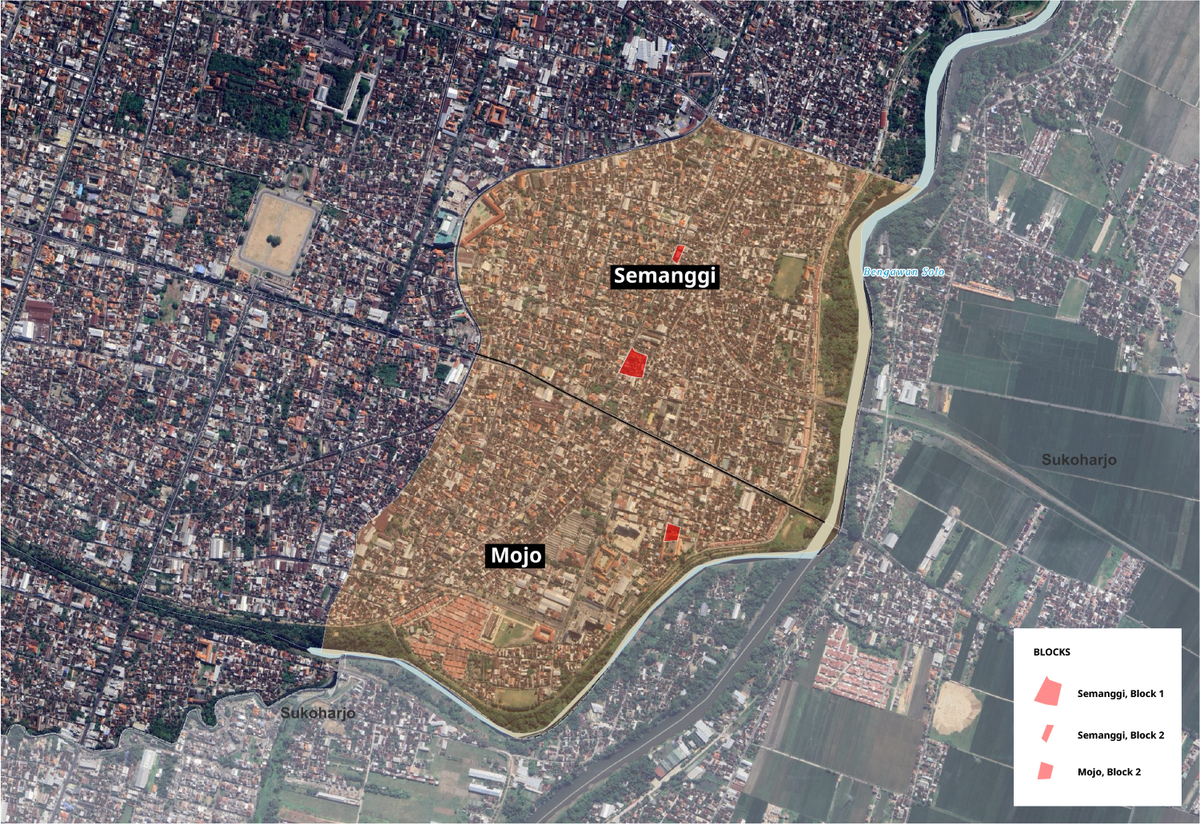
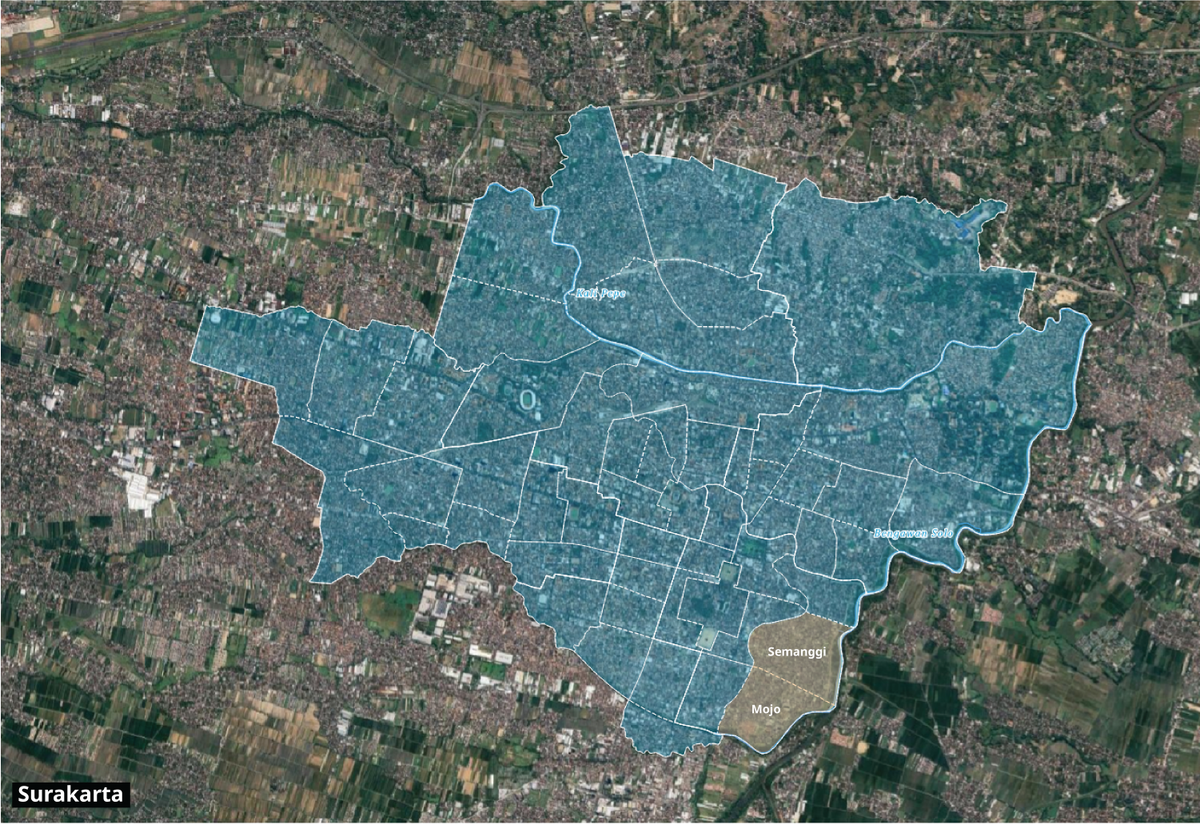
The project focuses on two sub-districts within Solo — Semanggi and Mojo — both located in the Pasarkliwon District. These neighborhoods were selected for their socio-spatial complexity and their relevance to community-driven upgrading initiatives.
Key contextual features include:
• High-density urban fabric: Compact settlement patterns shaped by incremental, self-built construction, reflecting the limited availability of formal housing.
• Environmental exposure: Communities experience recurrent flooding, water pollution, and overheating, revealing the intersections of environmental and infrastructural challenges.
• Local upgrading initiatives: Both areas have served as sites for various community-based housing and infrastructure improvements, providing a rich basis for comparative study.
• Thermal vulnerability: Urban Heat Island (UHI) mapping identifies these neighborhoods as thermal hotspots, underscoring the need for locally grounded, climate-responsive design approaches.
Located in southeastern Surakarta, Semanggi is one of the most densely populated urban areas in the city. It includes 16 community units (RW), 57 neighborhood units (RT), 7,654 households, and approximately 23,354 residents.
The community is socially diverse, home to both Javanese and Arab-Indonesian populations. Due to its density and low-lying position, it faces recurring flooding, poor ventilation, and limited infrastructure for waste and water management.
Mojo is a recently established sub-district, formed in 2018 after the administrative division of Semanggi. The Kyai Mojo Street serves as the dividing line — with Mojo to the south and Semanggi to the north.
Home to approximately 12,591 residents, Mojo exhibits similar settlement characteristics to Semanggi but represents a newer phase of urban consolidation and community-led adaptation.
The study operates at three interlinked analytical levels, enabling a comprehensive understanding of climate-responsive housing processes:
1) Macro Scale – Solo City
Analysis of city-wide patterns of urban growth, environmental risks, and housing typologies. This includes mapping Urban Heat Islands (UHI), flood-prone zones, and socio-spatial distributions of self-built settlements.
2) Meso Scale – Neighborhoods of Semanggi and Mojo
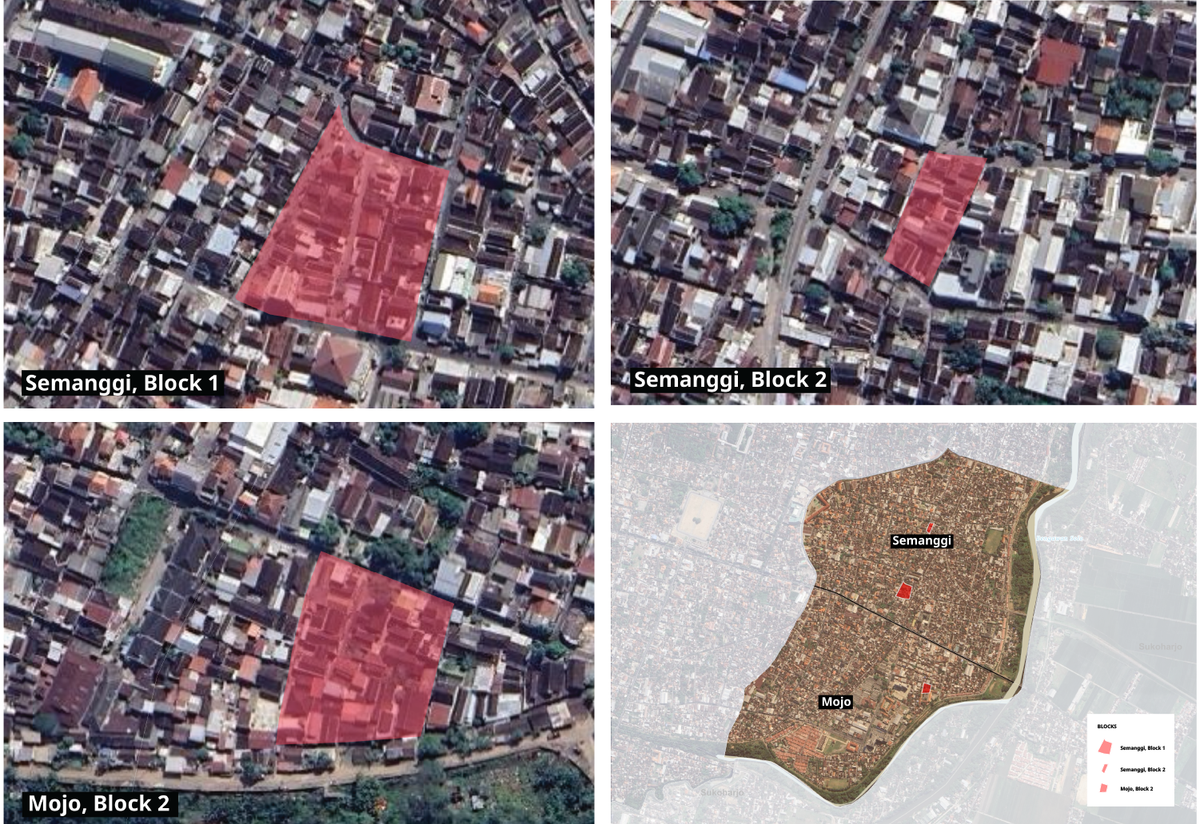
Investigation of social and spatial dynamics within the two case-study areas. This includes community infrastructure mapping, participatory observations, and assessments of social networks and adaptation practices.
3) Micro Scale – Housing Inventories
Detailed house-level surveys and inventories documenting construction materials, ventilation, shading, and water management. The focus is on identifying incremental adaptations and local design logics that respond to climatic challenges.